
Financial tombstones carry an air of solemn tradition, acting as the official paperwork for big-league transactions. These formal, often text-filled announcements show up in finance publications for good reason, yet many folks may not realize that while IPO and M&A tombstones use a similar dress code, they are actually performing quite distinct jobs.
An IPO tombstone is a carefully policed announcement, required by law, that puts the facts front and center. On the other hand, an M&A tombstone is more like a trophy on the mantle, advisors use it for bragging rights and to attract attention from potential future clients. The differences run deeper than just the looks.
What is the core purpose of each announcement?
Frankly, the entire conversation hinges on why these tombstones exist. Not all public financial announcements are built alike.
While you might think they’re just routine updates, the nature of an IPO tombstone’s purpose couldn’t be further from its M&A cousin. One operates under the watchful eye of regulations; the other is a mark of pride among advisors.
The role of an IPO tombstone
Picture the IPO tombstone as a polite doorman, carefully checking who comes and goes. Its real function is to publicly announce a new stock in a way that passes all legal requirements. It is not trying to win popularity points or jazz up the company’s reputation, it simply passes along the essentials.
You’ll find essential details like which banks are underwriting the deal and what’s on offer, and during the “quiet period” before an IPO, this kind of strictness is vital. Regulators don’t take kindly to companies making bold, promotional claims.

The role of an M&A tombstone
Now, take a different lens: the M&A tombstone is the corporate world’s version of a celebratory handshake. It isn’t just about marking a deal’s end; it’s about making it known that these advisors have done something notable.
After a merger or acquisition, everyone involved wants future clients to see their win, almost like athletes celebrating a championship.
These tombstones are typically released after papers have been signed, no longer tied down by strict regulatory ropes, and are important for cementing a firm’s reputation.
How do design and content rules differ?
Let’s not pretend the two tombstone types play by the same rulebook. Their appearances and what can be written on them are dictated by the jobs they have to do.
IPO tombstones answer to the SEC, which acts like a strict teacher checking every line, while M&A tombstones get more creative space, only needing to avoid misleading anyone.
Content requirements for IPO tombstones
Here, the SEC’s Rule 134 stands guard. It spells out what parties can and cannot say in these notices. By sticking to the letter of the law, companies gain a bit of legal breathing room to publicize essential information. What do these strict guidelines actually allow?
- The company’s name (called the issuer),
- The kind and quantity of shares or securities offered,
- All underwriter banks involved in the deal,
- A price range, but only if confirmed,
- And, always, a disclaimer making it crystal clear that this is not a sales pitch, but rather, information only provided via an official prospectus.
What never makes the cut? Any flattery, predictions, or sales tricks are completely off-limits, it’s rule-following at its finest.
Content conventions for M&A tombstones
An M&A tombstone, by contrast, has room to breathe. These announcements dodge micromanagement by regulators since they aren’t hawking new securities. Instead, M&A announcements stick to community expectations and some overall advertising standards, such as FINRA’s requirements for fairness and accuracy.
Usually, you’ll spot things like:
- The title of the deal (“Acquisition of Company X by Company Y,” for example),
- Names of all major companies joining the party,
- The deal’s size (assuming it isn’t hidden behind closed doors),
- And plenty of advisor shoutouts, with company names and even their corporate logos making an appearance.
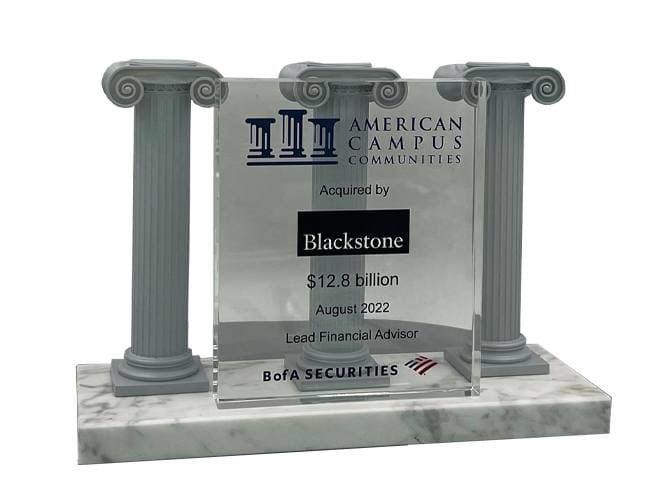
The sandbox is bigger here. Some advisors even commission glass or acrylic awards (informally called deal toys) to hand out, putting the M&A tombstone physically on full display. It’s much less rigid than the IPO world, that’s for sure.
Key differences at a glance: IPO vs M&A
To clear things up, here’s a quick look at the most influential contrasts between these two types of tombstones:
| Feature | IPO Tombstone | M&A Tombstone |
|---|---|---|
| Primary Purpose | Regulatory compliance; public notice of a securities offering | Commemoration; marketing for advisory firms |
| Regulatory Body | Heavily regulated by the SEC (Rule 134) | Governed by general advertising standards (FINRA Rule 2210) |
| Content | Strictly factual; issuer name, security type, underwriters, price | Transaction parties, deal value, advisor names and roles |
| Design | Minimalist, standardized, typically black-and-white | More creative freedom; may include logos, color, and custom layouts |
| Key Disclaimer | Mandatory legal legend stating it is not an offer to sell | General disclaimers to ensure the ad is not misleading |
| Timing | Published after filing a registration statement, often during the “quiet period” | Published after the transaction has been successfully completed |


Where can you find examples of these announcements?
Actually, tracking down a collection of tombstone ads can be surprisingly frustrating. For such a meaningful part of dealmaking, there’s no giant museum or gallery.
You’d expect big names like Morgan Stanley or Goldman Sachs to have vaults of these displayed, but a quick look at their websites usually leads nowhere.
Most people stumble across tombstones in finance-focused publications, think The Wall Street Journal or the Financial Times, where these announcements blink in and out of public sight.
In the end, it’s clear: whether it’s a game-changing IPO or a dramatic merger, the tombstone ad doesn’t just mark another transaction.
It’s a formal, lasting reminder of a significant achievement, almost like a snapshot in a business family album. While IPO tombstones stick to the straight and narrow for legal reasons, M&A tombstones happily shout about victory and experience. Each, undeniably, serves an important purpose in the story of finance.