
In a world where artificial intelligence can generate stunning concepts in seconds, it’s easy to believe that the hard part is already done.
It isn’t.
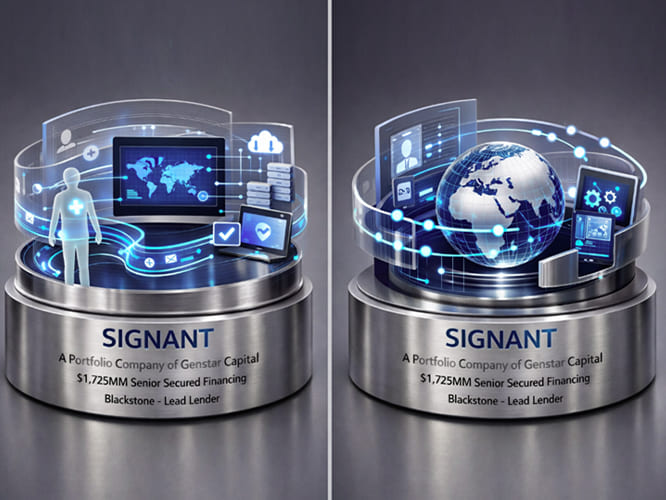
In November 2025, our team at GoLucites received an exciting inquiry from Blackstone. Along with their vision came something we are seeing more frequently: an AI-generated concept for a custom deal toy.
The render was impressive.
It captured the essence of the transaction and immediately communicated the story Blackstone wanted to tell. At first glance, it looked like a finished design, but anyone who has spent years designing and manufacturing premium deal toys knows there’s a significant difference between a beautiful image and a product that can actually be built.
That difference is where human expertise begins.
When AI Creates the First Draft
Artificial intelligence is an incredible source of inspiration. It can combine ideas, generate concepts, and visualize possibilities in ways that dramatically shorten the creative process.
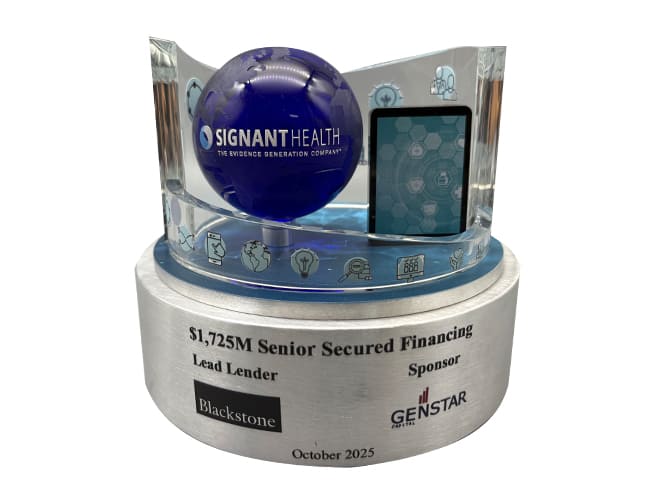
Blackstone’s initial concept reflected exactly that. It contained a globe, a digital tablet, floating healthcare icons, multiple layers of crystal, intricate engravings, and a modern architectural feel that represented Signant’s role in global clinical trials.
- It was creative.
- It was bold.
It was exactly the kind of concept that gets a designer excited.
But it also presented a question every manufacturer eventually has to answer: Can this actually be built?
The part AI doesn’t solve
This is where our team went to work.
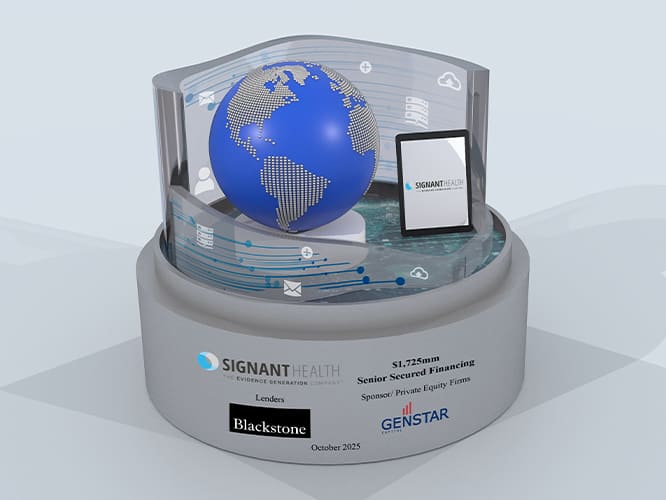
Rather than recreating the AI render exactly as it appeared, we analyzed every element through the lens of manufacturing, durability, materials, optics, balance, and production.
Some components had to be repositioned, others had to be resized.
Materials were selected not simply because they looked good on screen, but because they could produce the visual depth and premium finish expected from a Blackstone deal toy.
Even details that seem minor such as logo placement, engraving depth, spacing between healthcare icons, color matching, and how different crystal layers interacted with each other, required careful engineering.
Every revision brought the project one step closer to reality.
Collaboration beats automation
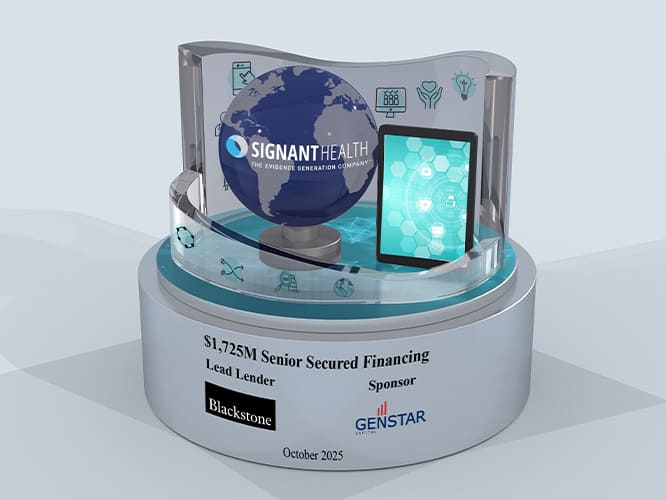
One of the most rewarding aspects of this project wasn’t the technology. It was the collaboration. The final product was the result of collaboration between Blackstone and GoLucites.
Over several months, Blackstone’s team provided thoughtful feedback after each design iteration.
- Could the globe become interactive?
- Could the healthcare icons better reflect Signant’s business?
- Could the tablet be repositioned?
- Would the spacing create a cleaner visual balance?
- Could the globe rotate?
Each question improved the final piece.
Instead of treating revisions as obstacles, both teams treated them as opportunities to refine the design until every detail met the standard expected for a commemorative award that executives would proudly display.
Great design rarely happens in a single version. It evolves.
Turning pixels into precision
Once the design was approved, another challenge began. The digital concept now had to become a physical object.
Our artists created the internal 3D engineering files and prototype production began.
Every transparent layer, engraving, printed element, and custom component had to align perfectly before mass production could even be considered.
A prototype was produced first. Images were reviewed. Additional refinements were made.
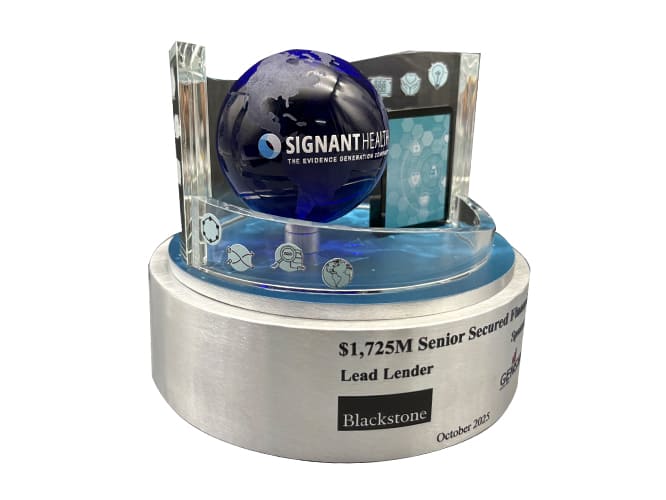
Only after every detail had been approved did we begin manufacturing the complete order.
This process may seem lengthy but in reality, it’s what transforms a premium executive award into something truly exceptional.
What this project taught us about AI
Projects like this remind us that AI isn’t replacing creativity. It’s changing where creativity begins.
Years ago, many conversations started with a blank sheet of paper. Today, they often begin with an AI-generated visualization. That’s progress.
But the journey from concept to completion still depends on people who understand materials, engineering, manufacturing, design principles, production limitations, and client expectations.
In other words, to summarize, AI generated the initial idea. Our clients refined the vision and GoLucites transformed that vision into a manufacturable, premium-quality deal toy.
It wasn’t AI alone. It wasn’t human expertise alone. We have to understand it has to be a combination of both and that’s what made this project successful.
At GoLucites, we welcome clients who arrive with sketches, napkin drawings, PowerPoint slides or even AI-generated concepts.
Because the most exciting part of our work isn’t where the idea comes from. It’s helping transform that idea into something people can hold in their hands for decades to come.